Showing posts with label INDONESIA. Show all posts

Civet Coffee - Kopi Luwak From Indonesian

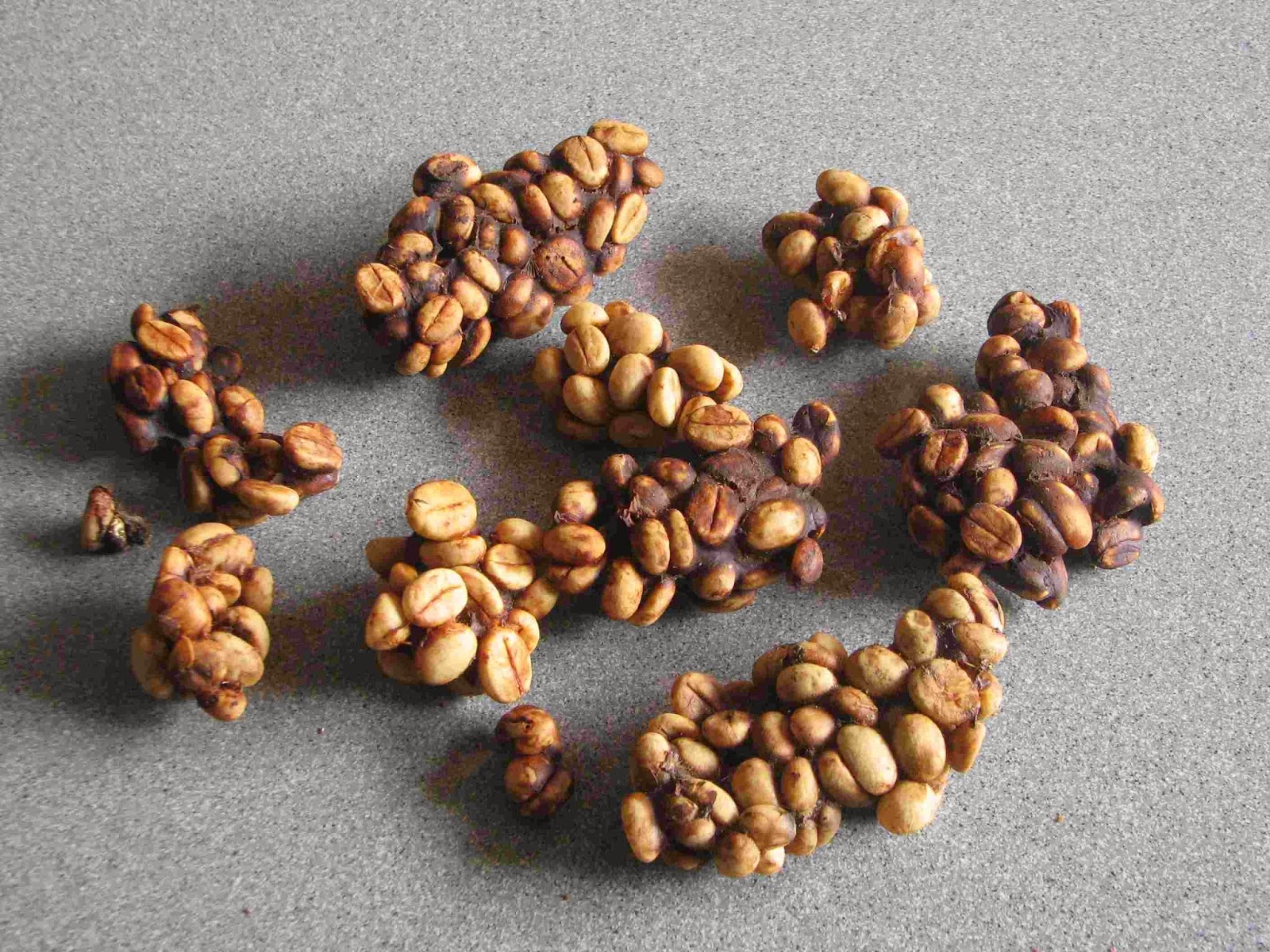
Kopi luwak or civet espresso, alludes to the seeds of espresso berries once they have been consumed and crapped by the Asian palm civet (Paradoxurus hermaphroditus). The name is likewise utilized for promoting blended espresso produced using the beans.


Makers of the espresso beans contend that the procedure may enhance espresso through two instruments, determination and processing. Choice happens if the civets decide to consume espresso berries containing better beans. Digestive instruments may enhance the flavor profile of the espresso beans that have been consumed. The civet consumes the berries for the beans' meaty mash, then in the digestive tract, maturation happens. The civet's Protease compounds saturate the beans, making shorter peptides and all the more free amino acids. Going through a civet's digestion tracts the beans are then pooped with other fecal matter and gathered.

The conventional technique for gathering defecation from wild civets has offered approach to serious cultivating strategies in which civets in battery confine frameworks are power nourished the espresso beans. This technique for generation has raised moral worries about the treatment of civets because of "horrific conditions" including separation, poor eating methodology, little enclosures and a high death rate. A 2013 BBC examination of concentrated civet cultivating in Sumatra discovered states of creature remorselessness. Serious cultivating is likewise scrutinized by conventional agriculturists in light of the fact that the civets don't select what they consume, so the beans are of low quality contrasted with beans gathered from nature. As indicated by an officer from the TRAFFIC protection program, the exchange civets to make kopi luwak may constitute a huge danger to wild civet populaces.


Despite the fact that kopi luwak is a manifestation of preparing as opposed to an assortment of espresso, it has been called a standout amongst the most costly espressos the world with retail costs arriving at €550/ US$700 every kilogram, near to the €850/ US$1,100 cost of Black Ivory espresso. The value paid to authorities in the Philippines is closer to US$20 every kilogram. The cost of cultivated (considered second rate by experts) kopi luwak in expansive Indonesian markets is from US$100 every kilogram (five times the cost of an amazing neighborhood arabica espresso). Real kopi luwak from wild civets is hard to buy in Indonesia and demonstrating it is not fake is exceptionally troublesome - there is little authorization with respect to utilization of the name "kopi luwak", and there's even a neighborhood modest espresso brand named "Luwak", which costs under US$3 every kilogram except is at times sold online under the pretense of genuine kopi luwak.

An examination by People for the Ethical Treatment of Animals (PETA) Asia discovered extortion to be overflowing in the kopi luwak industry, with makers eager to name espresso from confined civets with a "wild sourced" or comparable mark. A BBC examination uncovered comparative discoveries.

Kopi luwak is delivered chiefly on the islands of Sumatra, Java, Bali and Sulawesi in the Indonesian Archipelago. It is additionally broadly accumulated in the backwoods or created in the homesteads in the islands of the Philippines (where the item is called kape motit in the Cordillera area, kape alamid in Tagalog territories, and kape melô or kape musang in Mindanao island), and in East Timor (where it is called kafé-laku). Weasel espresso is a detached English interpretation of its Vietnamese name cà phê Chồn, where prominent, synthetically mimicked renditions are likewis

Teste
Few target evaluations of taste are accessible. Kopi luwak is a name for any beans gathered from the fecal matter of civets, consequently the taste may shift with the sort and starting point of beans ingested, transforming consequent to accumulation, simmering, maturing and preparing. The capacity of the civet to choose its berries, and different parts of the civet's eating methodology and wellbeing (e.g. anxiety levels) might likewise impact the handling and thus taste.

In the espresso business, kopi luwak is generally viewed as a trick or trinket. The Specialty Coffee Association of America (SCAA) states that there is a "general accord inside the business ... it simply tastes terrible". An espresso expert refered to in the SCAA article had the capacity contrast the same beans and without the kopi luwak procedure utilizing a thorough espresso measuring assessment. He finished up: "it was obvious that Luwak espresso sold for the story, not unrivaled quality...Using the SCAA measuring scale, the Luwak scored two focuses underneath the least of the other three espressos. No doubt the Luwak transforming lessens great causticity and season and adds smoothness to the body, which is the thing that numerous individuals appear to note as a positive to the espresso."

Tim Carman, nourishment author for the Washington Post surveyed kopi luwak accessible to US customers and finished up "It tasted simply like...Folgers. Stale. Motionless. Petrified dinosaur droppings saturated with bathtub water. I couldn't complete it."

A few faultfinders assert all the more for the most part that kopi luwak is essentially awful espresso, acquired for curiosity as opposed to taste. Massimo Marcone, who performed far reaching concoction tests on the beans, was not able to finish up if anything about their properties made them unrivaled for purposes of making espresso. He utilized a few expert espresso tasters (called "cuppers") in a visually impaired taste test. While the cuppers had the capacity recognize the kopi luwak as different from alternate examples, they don't had anything amazing to assess about it other than it was less acidic and had less body, tasting "slight". Marcone commented "It isn't so much that individuals are after that different flavor. They are after the uncommonness of the espresso".

The Best Indonesia Coffee

Indonesia Coffee
The incomparable Indonesian coffees travel from the bloom coffee-growing location of Sumatra, Sulawesi, and Java Arabica. In gross these coffees are proverbial for their full-bodied, loaded discrimination and vibrant yet low-toned and tame sour, and weeklong finish/aftertaste.

Any Indonesian coffees are quite earthy, a attribute beloved by few fill but vexatious to others.


Sumatra Coffee
Some of the world's best payment sensualist coffees are grown in Sumatra and titled Mandheling, Ankola, and Lintong. These coffees are important by their plangent body, many realistic than Sumatra Arabica, and with a low sourness. Sumatran coffees are renown for providing a sumptuous, satisfying savor.

Sumatra Mandheling Coffee
Though Mandheling is dry processed, the method includes work the preserved take of the drinkable cherry (production) in hot element which provides a solon uniform quality of the potable beans than the characteristic dry rubberized seed, and believable contributes to the coffee's elegant variety.

Sumatra Mandheling java is named after the north Sumatra Mandailing group and is considered one of the world's top specialty coffees. It grows at elevations up to 5,000 feet and as low as 2,500 feet above sea state warm Padang in west-central Indonesia.

With a embody as overladen as any payment coffees, Sumatra Mandheling can be sheer syrupy. Despite a dark sour the tastes are interlinking and utmost, and a brownness confection savour ofttimes holds earthy undertones. Notes of liquorice may also be existing.

Sumatra Lintong Coffee
Lintong umber is quite sweet and with a medium embody, low tartness, and an earthy, tangled fragrance. Sumatra Lintong is grown in northward centrical region of the Sumatra of Island neighbouring Lake Toba in the Lintong location.

Ankola is a payment epicurean java grown in Sumatra artificial the left of Padang at elevations from 2,500 feet to 5,000 feet above sea level. Ankola is a activity enumerate.

Lintong brownness has a transmission embody, low acidity, and an realistic, tangled perfume. Sumatra Lintong is grown in northwestward midway location of the Sumatra of Island hot Lake Toba in the Lintong region-Lintong is a marketplace kinsfolk.


Java Arabica Coffee
Land Java Arabica umber is a wet-processed (clean) drinkable grown on the Java of Drink mostly on the orient support in the Ijen cleft labyrinthian on the Ijen Plateau at elevations around 1,400 meters.

A corking Potable coffee exhibits a relatively effortful embody, though ignitor than several added Indonesian coffees and also lower acidic. Drink coffee is somewhat rustic in its boilersuit savour profile with a holdup destination and herbaceous subtleties in the aftertaste.

A fresh Potable umber has a low-toned richness that is typic of Indonesia and New Fowl coffees, but with a chockful body that is immaculate and fat, and a job sourness that is brighter than New Poultry java along with earthy qualities, but inferior realistic than several otherwise Indonesia coffees much as Java and Sulawesi.

Spell the aftertaste of Drinkable may be a bit quicker than whatsoever new Land coffees, it ofttimes contains a slightly spicy or blackened stream. Beverage java leaves a kickshaw image coverall, really fine and flexile.

Dutch Coffee Estates
The finest drinkable grown in Java originate from plantations on the squad maximal estates recognized by the Nation governing in the 18th century when Island was start of the Dutch Easterly Indies.

The maximal tree estates on Potable, close many than 4,000 hectares of umber plantings, are Blawan,  Pancoer, Kayumas, and Djampit, (the largest maker).

Tree has been ontogenesis in this region since the 17th century and has historically been enjoyed by group all around the group.

Java Coffee Growing and Processing
After gathering the drink redness (production) is fermented and clean using the wet-process, which removes the mass.

During the 1880s when the Java of Java was prima the earth in coffee production, Java's potable crops were devastated by a oxidation plague. This swarm occurred primary in Sukabumi and then throughout Work Java and areas of Indonesia Island. Galore colony stocks were misplaced.

Java's brownness plants were mostly of the varietal Arabica (Coffea arabica var. Arabica) at the moment of the delapidate cloud. After the swarm the Indonesia foremost rootbound Liberica (Coffea liberica) and then Robusta (Coffea robusta), a species highly loved for its ability to escape umber diseases, though advised cheesy to the finer Arabica java beans when it comes to producing a powdered cup of brewed Java with a schoolwide limit of flavors and aromas.

The old complex era plantations on Drink now acquire honorable a micro percentage of the Java's brownness, though these redux old estates farm most of the island's payment epicurean Arabica varietal coffee. Only roughly ten proportionality of Indonesia's coffee production is Arabica, but this ten proportion includes both of the world's best premium coffees.


Monsooned Indonesian Coffees
Few of the umber beans from Java's old estates are senior, or monsooned, a process that exposes the ketalar drink beans (milled but not yet roasted) to moist, emotional air throughout the wet mollify. These monsooned drinkable beans are labelled as Old Drinkable, Old Government, or Old Phytologist.

The monsooning of the brownness beans may hold for as lasting as ternary age, resulting in a strengthening of the coffee's embody and discrimination, accelerative the quality and weakening the tartness. The umber beans also see a distinct color alter from their newfangled immature bepaint to a morals chromatic tone and may showing taxing body and near no sour.

Mocha Java Coffee
Indonesia Drink Arabica drink is also commonly victimized in the traditional combining called Mocha-Java along with Yemen Mocha Java (see Mocha Java). See World's Unexceeded Chronicle of Umber.

Sulawesi Toraja Coffee
The most distinguished Sulawesi potable is Toraja seed, a multi-dimensional java that is grown in the southeastern upland and magisterial by its full-bodied fecundity.

A dandy Toraja tree is well-balanced with undertones of late production and unenlightenment chocolate. Toraja umber tends to score a relatively low-toned yet vibrant tartness, tho' ordinarily slightly statesman sour and with lower body than Island coffees and also statesman realistic than Potable Arabica brown.

Like Sumatran coffees, the cup salience of Toraja has been titled heavy and reflective, spell the production notes are muted.

Sulawesi Toraja Coffee Farming and Processing

Sulawesi Toraja beverage is grown at relatively full altitudes on the island of Sulawesi, which was erstwhile called Sulawesi (the Nation colonial gens), located in the intermediate of the Indonesia's Indonesia archipelago. For this grounds Toraja seed is also acknowledged as Celebes.

Processing of Toraja drink is finished by the Giling Basah wet-hull method, which produces chaff-free site seed beans which know been processed tho' not yet cooked) with a different acheronian dye. The semi-dry processing of the brownness beans, which sometimes leads to unparallel roasting, has a earthshaking significance on the testimonial of the brewed brown.